



There’s nothing worse than the afternoon slump that often hits around 3:00 pm. You’re cruising through your day, tackling your to-do list, and then all of a sudden, it feels like you’ve hit a wall. A wave of exhaustion sets in, focus drifts, and motivation goes out the window.

The afternoon slump is real for many of us, and pushing through can be a challenge. The common fix is often to reach for a second, or even a third cup of coffee, or grab a sugary snack. But that often only leads to jitters, poor sleep, or even a bigger energy crash later on.
If you’re looking for a steady, nourishing pick-me-up that won’t sabotage your evening, matcha might be the perfect choice.
Here’s how it can help
Why matcha works for an afternoon energy boost

Matcha has a unique combination of caffeine and L-theanine, an amino acid known for its relaxing properties. Unlike coffee, which gives you a quick jolt of caffeine, matcha offers a smoother and more sustained energy boost.
L-theanine has been shown to promote relaxation and mental clarity, thereby balancing out the stimulating effects of caffeine. This is why matcha is so famous for its calm focus- a state of alertness without the anxious edge.
Matcha is also a rich source of antioxidants, particularly EGCG, which may help support overall health and even improve mood. Instead of overstimulating your system, matcha can help gently support it, making it ideal for powering through the latter part of your day.
When should you drink matcha for energy?
If you want energy and more mental clarity, drinking matcha in the morning can be a great choice. It also provides a more sustained energy lift, which may help you avoid that afternoon crash altogether. Studies show that matcha can help improve cognitive function, alertness, and even memory. A perfect ally against your long to-do list.
If you need a little extra, most people find that having a cup of matcha in the afternoon, somewhere around 2:00 pm, is enough to fight off that afternoon slump without interfering with sleep later on. Just remember that it does contain caffeine, so if you’re sensitive, you may want to bump that up to around 12:00 pm.
Caffeine in matcha

So how much caffeine does matcha really have? It depends! On average, a gram of matcha contains about 20-45 mg of caffeine. With a normal serving being somewhere between 2 and 4 grams (1-2 teaspoons, depending on how strong you like your matcha), that’s around 40-180 mg of caffeine per cup of matcha. The variation stems from a huge difference in the quality of matcha powders. Generally, a higher-quality matcha contains more caffeine. Matcha also provides a longer-lasting alertness, without the jitters. So, you don’t need to drink as much to reap the benefits.
Read more about the caffeine in matcha here.
Best ways to enjoy matcha

One of the things we love most about matcha is its versatility. Here are a few simple ways you can incorporate it into your afternoon ritual:
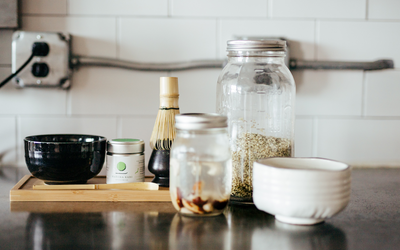
Matcha latte: Whisk matcha with hot water, then add warm frothed milk. Easy and delicious!
Iced Matcha: Perfect for warmer days or when you’re on the go. Blend matcha with cold water and pour over ice. Top with milk and sweetener if desired.
Matcha & Pineapple: Both matcha and pineapple juice have been shown to help improve digestion and alleviate bloating, which can often occur in the afternoons. Add matcha to cold water and whisk well, then pour in a splash of pineapple juice for a gut-healthy pick-me-up.
Matcha snacks: Matcha energy balls, smoothie bowls, or Matcha bars are all great ways to get the benefits of matcha in a tasty package.
Check out all of our delicious matcha recipes here
Bottom Line:
Instead of relying on another cup of coffee or sugar snacks, opt for a cup of matcha for an afternoon energy boost. It contains a unique blend of L-theanine and caffeine, offering a calm, sustained focus without the crash. Matcha is also high in antioxidants and other health-boosting properties.
Grabbing a cup of matcha might just be exactly what you need to finish your day with clarity, focus, and energy.
Resources:
Kochman J, Jakubczyk K, Antoniewicz J, Mruk H, Janda K. Health Benefits and Chemical Composition of Matcha Green Tea: A Review. Molecules. 2020 Dec 27;26(1):85. doi: 10.3390/molecules26010085. PMID: 33375458; PMCID: PMC7796401.
Baba Y, Inagaki S, Nakagawa S, Kobayashi M, Kaneko T, Takihara T. Effects of Daily Matcha and Caffeine Intake on Mild Acute Psychological Stress-Related Cognitive Function in Middle-Aged and Older Adults: A Randomized Placebo-Controlled Study. Nutrients. 2021 May 17;13(5):1700. doi: 10.3390/nu13051700. PMID: 34067795; PMCID: PMC8156288.
Liu C, Wang L, Zhang C, Hu Z, Tang J, Xue J, Lu W. Caffeine intake and anxiety: a meta-analysis. Front Psychol. 2024 Feb 1;15:1270246. doi: 10.3389/fpsyg.2024.1270246. PMID: 38362247; PMCID: PMC10867825.
Hidese S, Ogawa S, Ota M, Ishida I, Yasukawa Z, Ozeki M, Kunugi H. Effects of L-Theanine Administration on Stress-Related Symptoms and Cognitive Functions in Healthy Adults: A Randomized Controlled Trial. Nutrients. 2019 Oct 3;11(10):2362. doi: 10.3390/nu11102362. PMID: 31623400; PMCID: PMC6836118.
Unno K, Noda S, Kawasaki Y, Yamada H, Morita A, Iguchi K, Nakamura Y. Reduced Stress and Improved Sleep Quality Caused by Green Tea Are Associated with a Reduced Caffeine Content. Nutrients. 2017 Jul 19;9(7):777. doi: 10.3390/nu9070777. PMID: 28753943; PMCID: PMC5537891.
Disclaimer: These statements in this blog post have not been evaluated by the Food and Drug Administration. The information provided here is for educational purposes only and should not be considered medical advice. It's essential to consult with a qualified healthcare professional before making any dietary or lifestyle changes.