



Running low on sleep? You’re going to want to read this.
With stress, screens, and erratic schedules disrupting our circadian rhythms, getting good, quality rest may feel harder than ever. While many people turn to coffee or energy drinks to help them power through the day, that same jittery jolt that keeps them awake during the day may also be sabotaging their sleep at night.
Matcha, a form of green tea that has been used in Japan for centuries, offers a gentler, more balanced form of energy. It contains a unique combination of L-theanine, antioxidants, and a lower caffeine content that can support better quality sleep, rather than wreck it. Switching to matcha may also help you avoid the unwanted side effects many people experience from being overly caffeinated, such as anxiety, energy crashes, and cortisol spikes.

Keep reading to learn eight reasons why drinking matcha can help you feel more energized during the day and rested at night.
1. L-theanine promotes relaxation

L-theanine is a non-essential amino acid known for encouraging a state of relaxation. It doesn’t make you drowsy or directly induce sleep, but it can help regulate mood, reduce stress, and increase calming hormones- all of which can be beneficial for sleep. Studies examining the effects of L-theanine supplementation on sleep quality found that it significantly improved sleep onset and latency (i.e., the time it takes to fall asleep). L-theanine has also been shown to promote the production of relaxing brain waves, known as alpha waves, which can help to reduce anxiety. This allows the mind to relax, which can play a significant role in achieving better sleep.
2. Balanced energy without the crashes
Unlike energy drinks or coffee, which deliver a fast hit of caffeine, the caffeine in matcha is absorbed more slowly, thanks to the presence of L-theanine. This helps to buffer the stimulating effects of caffeine and provides a more stable energy source throughout the day. That means fewer afternoon crashes (and fewer desperate grabs for more caffeine or sugar snacks), which helps your sleep/wake cycle regulate, so you actually feel tired by bedtime. Over time, this helps to reinforce a healthier circadian rhythm- you’re working with your body rather than against it.
3. Supports cortisol regulation

Chronic stress and elevated cortisol levels can disrupt sleep in a big way. Excess caffeine can spike cortisol even higher, compounding the issue. Caffeine blocks adenosine receptors in the brain, which promotes relaxation. However, Matcha has been shown to help improve the body’s stress response. Thanks to both L-theanine and matcha’s polyphenols, matcha can help support healthy cortisol levels, which may support a calmer nervous system, laying the groundwork for better sleep.
4. Reduces inflammation

Sleep and inflammation have a complex relationship. Chronic sleep disturbances can contribute to inflammation, and chronic inflammation can, in turn, contribute to poor sleep. Elevated inflammation has been linked to both insomnia and poor sleep quality. Matcha is especially rich in an antioxidant known as EGCG, which can help combat and reduce inflammation. By reducing inflammation, matcha can support overall health and set the stage for deeper, more restorative sleep.
5. Helps balance blood sugar
It’s normal for blood sugar to vary throughout the day, but big swings can lead to nighttime wake-ups, especially between 2-4 a.m. Matcha contains catechins, which have been shown to help improve insulin sensitivity and help stabilize blood sugar levels. When consumed in the morning (or early afternoon), matcha can help maintain more stable energy and glucose levels, resulting in fewer blood sugar dips that can disrupt your sleep.
6. Supports gut health and digestion
Did you know that your gut health plays an important role in your sleep quality? The microbes in your gut help produce neurotransmitters like serotonin and melatonin, both of which play key roles in your sleep-wake cycle. The polyphenols in matcha can help support a healthy gut microbiome by acting as prebiotics and soothing irritation and inflammation in the gut lining. A balanced gut can help with better digestion, reduced bloating, a more even mood, and even more restful sleep.
7. Encourages a healthy ritual

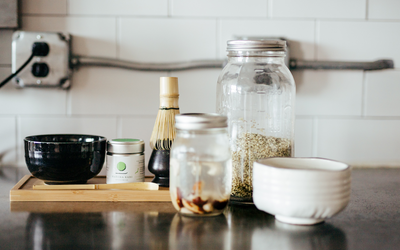
Preparing and drinking matcha is really meant to be enjoyed as a ritual, one that encourages you to slow down, focus on your breath, and be present. The act of making matcha can help signal to your nervous system that it’s time to shift out of fight-or-flight mode and into a more relaxed state. While this seems simple, including more of these moments throughout your day can help to reduce stress and anxiety, improve your mood, and therefore (hopefully) improve sleep.
8. Replaces less ideal caffeine sources

It’s common for many to reach for multiple cups of coffee or energy drinks throughout the day- only to find themselves feeling wired and unable to fall asleep by bedtime. Switching to matcha can help break the overcaffeinated, underslept cycle. It’s a gentler, more supportive form of energy and contains L-theanine, which delivers alertness without the anxiety or cortisol spike. For many, simply replacing a second cup of coffee with matcha is enough to notice a major improvement in sleep.
If you’re looking for a better night’s sleep, consider switching from coffee (or energy drinks) to matcha. Just be mindful that matcha does still contain caffeine, so it’s best enjoyed in the morning or early afternoon, particularly if you’re sensitive to caffeine. If you want to drink matcha in the evening, try our decaf matcha!
Bottom line
Matcha isn’t a sedative or a supplement. It’s a ritual that can help calm your nervous system, reduce stress, and provide valuable nutrients that can all help you get a better night’s rest. If you’ve never tried matcha but are curious to see if it can help you sleep better, try swapping your afternoon coffee for a matcha for one week to see how you feel!
Disclaimer: These statements in this blog post have not been evaluated by the Food and Drug Administration. The information provided here is for educational purposes only and should not be considered medical advice. It's essential to consult with a qualified healthcare professional before making any dietary or lifestyle changes.
Resources:
Amanda Bulman, Nathan M. D’Cunha, Wolfgang Marx, Murray Turner, Andrew McKune, Nenad Naumovski, The effects of L-theanine consumption on sleep outcomes: A systematic review and meta-analysis, Sleep Medicine Reviews, Volume 81, 2025, 102076, ISSN 1087-0792, https://doi.org/10.1016/j.smrv.2025.102076.
Rao TP, Ozeki M, Juneja LR. In Search of a Safe Natural Sleep Aid. J Am Coll Nutr. 2015;34(5):436-47. doi: 10.1080/07315724.2014.926153. Epub 2015 Mar 11. PMID: 25759004.
Lovallo WR, Farag NH, Vincent AS, Thomas TL, Wilson MF. Cortisol responses to mental stress, exercise, and meals following caffeine intake in men and women. Pharmacol Biochem Behav. 2006 Mar;83(3):441-7. doi: 10.1016/j.pbb.2006.03.005. Epub 2006 May 2. PMID: 16631247; PMCID: PMC2249754.
Unno K, Furushima D, Hamamoto S, Iguchi K, Yamada H, Morita A, Horie H, Nakamura Y. Stress-Reducing Function of Matcha Green Tea in Animal Experiments and Clinical Trials. Nutrients. 2018 Oct 10;10(10):1468. doi: 10.3390/nu10101468. PMID: 30308973; PMCID: PMC6213777.
Feuth, T. (2024). Interactions between sleep, inflammation, immunity and infections: A narrative review. Immunity, Inflammation and Disease, 12, e70046. https://doi.org/10.1002/iid3.70046
Wen L, Wu D, Tan X, Zhong M, Xing J, Li W, Li D, Cao F. The Role of Catechins in Regulating Diabetes: An Update Review. Nutrients. 2022 Nov 4;14(21):4681. doi: 10.3390/nu14214681. PMID: 36364943; PMCID: PMC9654920.