



Summer is somehow both energizing- a time of renewed motivation- and overstimulating and exhausting. With longer days, travel, social plans, no school, and heat, it’s normal to feel a bit ungrounded this time of year. While we often think of fall as the season for routine, summer may be when it actually matters most.

The good news is that it can be relatively easy to feel a bit more grounded, and all you need to do is return to a few simple practices each morning. Getting some early light, eating a nourishing breakfast, taking a few quiet moments to yourself before starting the day, or preparing your morning matcha can all be small ways to anchor yourself this season.
And there’s science to support that small, repeated morning habits can influence circadian rhythms, stress resilience, energy regulation, and focus.
Get Some Morning Light

One of the best ways to ground your body is to step outside in the morning.
Exposure to natural light soon after waking helps reinforce circadian rhythms, your body’s internal clock that influences sleep, hormones, metabolism, and mood. Morning light also supports the natural cortisol awakening response, which is a healthy rise in cortisol that helps promote alertness and energy early in the day.
Even taking a 5-minute walk outside, or enjoying your morning tea with your feet in the grass, can help set a steadier rhythm for the day and night. If getting outside isn’t an option first thing, try sitting in front of an open window.
Hydrate First
Hot weather naturally increases our fluid needs. Even mild dehydration, which a lot of us probably experience daily, can affect concentration, mood, and energy. Even just a 1% water loss can spike cortisol and increase irritability and anxiety. We also naturally wake up a bit dehydrated after a full night's sleep, so focusing on hydration is especially important in the morning.
Try starting your day with a big glass of water before you drink anything else. It can be a simple but powerful way to set yourself up for success. If you don’t enjoy the taste of plain water, add a spritz of lemon or even a pinch of mineral salt.
It’s easy to underestimate how important staying hydrated is to feeling calm and grounded.
Read more about how matcha can help you stay hydrated here.
Swap Your Morning Coffee for Matcha

For many people, summer is a great time to try healthier habits. If you’ve been feeling like coffee just isn’t supporting you anymore, give matcha a try! Swapping one cup of coffee for matcha might make a big difference in how you feel.
One of the things people love most about matcha is how it makes them feel. It has a unique combination of caffeine and L-theanine, which research suggests can support alertness and focus while promoting a calmer, steadier energy. That balanced effect can help you feel energized without the sharper peaks that can sometimes happen with coffee.
The ritual itself also has a lot of perks.
Making matcha is a great opportunity to pause and slow down, if only for a moment. That can be grounding in its own right.
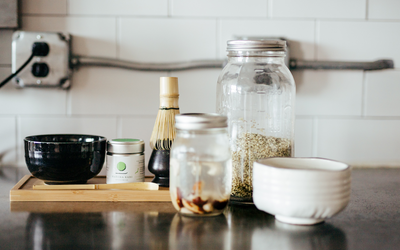
In summer, this might look like a traditional warm bowl enjoyed in the quiet of the morning, or an iced matcha taken outside into the early light. Either way, you may just notice that making matcha becomes less about a caffeine boost and more about how you want to start the day.
Eat a Solid Breakfast

Don’t neglect the impact nutrition has on feeling grounded. And if you want to feel better in the morning (and all day long), breakfast is the place to start.
Eating a balanced breakfast that includes protein, fiber, and healthy fats can support steadier blood sugar and more sustained energy, which may be especially important in summer, when irregular schedules can lead to skipped meals.
Think:
-
Eggs with a handful of spinach, chopped bell pepper, and a slice of whole-grain bread.
-
Yogurt with berries and seeds
-
Overnight oats with chia and almond butter
-
Toast with avocado and hemp seeds
Check out our delicious matcha recipes here to get you inspired.
Be Slow To Open Your Phone

Before looking at your phone to open an email or scroll, create a little ritual.
Even taking 3-5 minutes to journal, stretch, breathe, read, or simply sit quietly can help reduce the feeling that you have to be “on” right away.
Growing research suggests that small moments of intentional slowing down can support nervous system regulation. The feeling of being grounded usually comes less from doing more and more from doing less.
Say "No" More
Summer can be a really busy time. With BBQs, backyard hangouts, concerts, sports, and vacations, it can be tough to find any time to just relax or be at home.
If what you need to feel more grounded is permission to say no a bit more, we’ve got you! Remember, you can’t pour from an empty cup.
Bottom Line
We often think grounding requires big lifestyle changes, but a few small habits can go a long way. Getting morning light, drinking a big glass of water, eating a nourishing breakfast, and preparing matcha with intention can all help anchor you. Plus, these habits can serve you all year long!
Resources:
de Menezes-Júnior LAA, Sabião TDS, Carraro JCC, Machado-Coelho GLL, Meireles AL. The role of sunlight in sleep regulation: analysis of morning, evening and late exposure. BMC Public Health. 2025 Oct 6;25(1):3362. doi: 10.1186/s12889-025-24618-8. PMID: 41053799; PMCID: PMC12502225.
Zhang N, Du SM, Zhang JF, Ma GS. Effects of Dehydration and Rehydration on Cognitive Performance and Mood among Male College Students in Cangzhou, China: A Self-Controlled Trial. Int J Environ Res Public Health. 2019 May 29;16(11):1891. doi: 10.3390/ijerph16111891. PMID: 31146326; PMCID: PMC6603652.
Moshfeghinia R, Sanaei E, Mostafavi S, Assadian K, Sanaei A, Ayano G. The effects of L-theanine supplementation on the outcomes of patients with mental disorders: a systematic review. BMC Psychiatry. 2024 Dec 4;24(1):886. doi: 10.1186/s12888-024-06285-y. PMID: 39633316; PMCID: PMC11616108.
Kurauchi Y, Ohta Y, Matsuda K, Sanematsu W, Devkota HP, Seki T, Katsuki H. Matcha Tea Powder's Antidepressant-like Effect through the Activation of the Dopaminergic System in Mice Is Dependent on Social Isolation Stress. Nutrients. 2023 Jan 22;15(3):581. doi: 10.3390/nu15030581. PMID: 36771286; PMCID: PMC9921318.
Pruessner JC, Dedovic K, Pruessner M, Lord C, Buss C, Collins L, Dagher A, Lupien SJ. Stress regulation in the central nervous system: evidence from structural and functional neuroimaging studies in human populations - 2008 Curt Richter Award Winner. Psychoneuroendocrinology. 2010 Jan;35(1):179-91. doi: 10.1016/j.psyneuen.2009.02.016. PMID: 19362426.
Murray, Gottlieb & Swartz. Maintaining Daily Routines to Stabilize Mood: Theory, Data, and Potential Intervention for Circadian Consequences of COVID-19.