



Parenthood is filled with immeasurable joy… and a lot of germs. Between broken sleep, packed schedules, stress, and pretty much daily exposure to colds and bugs, your immune system is likely working overtime. Many parents are also running on empty, which can make caffeine feel non-negotiable.

For many, coffee has become a lifeline. But while it can provide a quick energy boost, it may also add to the stress and increase jitters, anxiety, and energy crashes. Which may be especially true when your body is already depleted. Matcha, on the otherhand, has a unique combination of caffeine, L-theanine, and antioxidants, which gives it a much more balanced form of energy that may better support immune resilience during this demanding season of life.
Why your immune system is under pressure as a parent
Being a parent is demanding in ways that directly affect health and immunity.
Sleep deprivation is one of the biggest challenges most parents face at one point or another. Poor sleep has been shown to reduce immune cell activity and increase systemic inflammation. Research suggests that people who don’t get enough sleep are more likely to get sick after viral exposure and may also take longer to recover. Sleep is a critical time for immune repair: while we sleep, the body produces cytokines - proteins that help regulate immune responses and are especially important during stress or illness. Chronic sleep loss can also reduce antibody production, weakening the body’s ability to fight infection.

Chronic stress is another major factor. Stress, especially when ongoing, can raise cortisol levels over time. While cortisol is a necessary hormone and plays a role in short-term stress responses, chronically elevated levels can suppress immune function, increase inflammation, and lower lymphocyte counts (white blood cells that help fight pathogens). Stress doesn’t just affect how often you get sick; it can also affect how well and how quickly you recover.
And then there’s constant exposure to germs. When you have kids, your immune system is almost always “on,” responding to new viruses and bacteria. Over time, that constant activation can be draining if the body isn’t adequately supported.
For parents, immune health may be less about “boosting” the immune system (although that can be needed sometimes too!) and more about supporting health and resilience. With an overall goal of helping the body respond appropriately to stress and germs without burning out.
Coffee vs. matcha for immune health

Both coffee and matcha contain caffeine, and for many parents, caffeine is an essential part of getting through the day. But caffeine in matcha can feel different for many compared to the caffeine in coffee. And that can matter, especially in the context of stress, inflammation, and sleep deprivation.
Coffee delivers a fast jolt of energy by strongly stimulating the central nervous system. While that energy boost can be helpful in the short term, it may come with trade-offs: spikes in cortisol, jitters, increased anxiety, energy crashes, and disrupted sleep later. Coffee itself isn’t inherently bad, but for people under constant pressure, like parents, drinking excessive amounts may contribute to a cycle of overstimulation followed by depletion.
Matcha, on the other hand, contains caffeine and the amino acid L-theanine, which can alter how the body responds to caffeine. L-theanine promotes a sense of calm focus, helping you feel alert without feeling wired. This can be especially supportive for parents whose nervous systems are already under strain.
Matcha is also rich in antioxidants, particularly EGCG (epigallocatechin gallate), which has been studied for its role in reducing oxidative stress and supporting immune function. Oxidative stress and chronic inflammation are closely linked, and reducing that burden may help the immune system function more efficiently.
Rather than pushing the body to do more with less, matcha supports steadier energy and a calmer stress response, which may help the immune system work more effectively.
Thanks to L-theanine’s stress-modulating effects, matcha may also help keep cortisol levels in check - or at the very least, won’t add to the stress you’re already feeling. And while matcha still contains caffeine, many people find it less disruptive to sleep than coffee. However, those sensitive to caffeine should avoid stimulants after noon.
How to make the swap to matcha

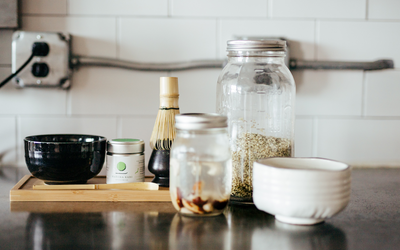
A little goes a long way, especially if you’re new to matcha. One of the easiest ways to transition is to prepare matcha the same way you enjoy your coffee.
-
If you drink black coffee, try matcha the traditional way with just hot water.
-
If you add milk or cream, a matcha latte might be a more natural swap.
Start with ½–1 teaspoon of matcha powder mixed into about 8 ounces of water or milk. Choose a high-quality matcha to avoid contaminants, achieve the best flavor, and maximize health benefits.
Like most habits, matcha works best when it’s part of a consistent routine, not just a last-minute rescue on exhausting days.
Check out all our matcha recipes for some great ideas!
Bottom Line
For parents navigating chronic stress, broken sleep, and constant exposure to germs, small daily choices matter. Swapping coffee for matcha won’t eliminate the challenges of parenthood—but it may offer calmer energy, better stress balance, and gentler support for your immune system when you need it most.
Disclaimer: These statements in this blog post have not been evaluated by the Food and Drug Administration. The information provided here is for educational purposes only and should not be considered as medical advice. It's essential to consult with a qualified healthcare professional before making any dietary or lifestyle changes.
References:
Alotiby A. Immunology of Stress: A Review Article. J Clin Med. 2024;13(21):6394. doi:10.3390/jcm13216394.
Besedovsky L, Lange T, Born J. Sleep and immune function. Pflugers Arch. 2012 Jan;463(1):121-37. doi: 10.1007/s00424-011-1044-0. Epub 2011 Nov 10. PMID: 22071480; PMCID: PMC3256323.
Hedva Haykin, Asya Rolls, The neuroimmune response during stress: A physiological perspective, Immunity, Volume 54, Issue 9, 2021, Pages 1933-1947, ISSN 1074-7613,
https://doi.org/10.1016/j.immuni.2021.08.023. (https://www.sciencedirect.com/science/article/pii/S1074761321003575)
Jiachen Sun, Shengjie Dong, Jianying Li, Hui Zhao, A comprehensive review on the effects of green tea and its components on the immune function, Food Science and Human Wellness, Volume 11, Issue 5, 2022, Pages 1143-1155, ISSN 2213-4530,
https://doi.org/10.1016/j.fshw.2022.04.008.
Richards G, Smith A. Caffeine consumption and self-assessed stress, anxiety, and depression in secondary school children. J Psychopharmacol. 2015 Dec;29(12):1236-47. doi: 10.1177/0269881115612404. Epub 2015 Oct 27. PMID: 26508718; PMCID: PMC4668773.
Muhammad Liaquat Raza, Motahareh Haghipanah, Nasrollah Moradikor,
Chapter Four - Coffee and stress management: How does coffee affect the stress response, Editor(s): Nasrollah Moradikor, Indranath Chatterjee, Progress in Brain Research, Elsevier, Volume 288, 2024, Pages 59-80, ISSN 0079-6123, ISBN 9780443316340, https://doi.org/10.1016/bs.pbr.2024.06.013. (https://www.sciencedirect.com/science/article/pii/S0079612324001092)
Unno K, Yamada H, Iguchi K, Ishida H, Iwao Y, Morita A, Nakamura Y. Anti-stress Effect of Green Tea with Lowered Caffeine on Humans: A Pilot Study. Biol Pharm Bull. 2017;40(6):902-909. doi: 10.1248/bpb.b17-00141. PMID: 28566632.