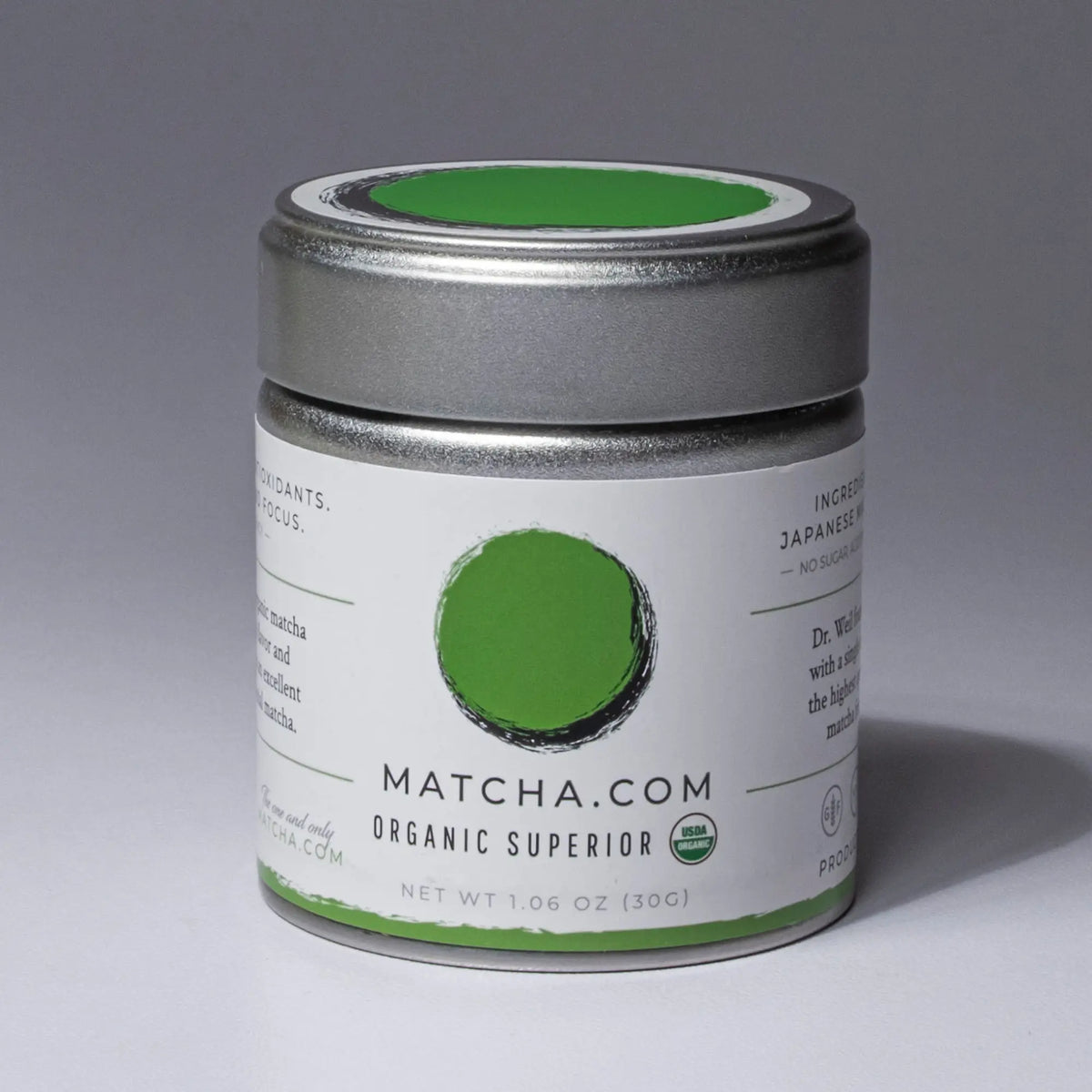


Have you ever found yourself wondering, "What is the difference between matcha vs. green tea?" You're not the only one! While green tea has long been linked to various health benefits, a brighter shade of green tea is stealing the spotlight: matcha powder.
Each form of these two types of green tea have notable benefits for the body, though some people may prefer the flavor, preparation, and properties of one vs. the other.
Keep reading to find out precisely how matcha powder is different from green tea and why it's widely considered the healthiest type of green tea available.

Comparing two types of green tea
Matcha and green tea both come from the same tea plant native to China, known as Camellia sinensis, which can be traced back almost 5,000 years to ancient China. This is actually the same plant that is used to create other types of teas, such as black tea, oolong tea, and white tea varieties.
 Matcha is a type of green tea that uses specific growing and processing techniques developed in Japan that alters Camellia sinensis into matcha powder.
Green tea is a brewed loose leaf or bagged tea, whereas matcha is a finely powdered tea with much higher amounts of caffeine, antioxidants, and supportive health benefits. This is due to how matcha is grown, harvested, manufactured, prepared, and consumed compared to green tea.
Learn more about different types of teas here.
How is green tea harvested and manufactured?
Conventionally, green tea is grown out in the sun until it is harvested. Farmers then harvest green tea leaves and quickly thereafter heat them, which prevents the tea leaves from oxidizing and becoming brown. Then, depending on the specific type of green tea, different processing methods are used – such as sun drying, steaming, or pan firing.
Green tea is then rolled and dried, left in its final form to be steeped in hot water to create tea.
How is matcha harvested and manufactured?
For growing traditional Japanese-style matcha, Camellia sinensis tea bushes are covered to stay in the shade for the last several weeks before harvest.
The shading helps increase the amount of chlorophyll in the leaves, leading to denser shades of emerald green in the matcha tea leaves than loose leaf and bagged green tea leaves.(6)
Following the harvest, done by hand to select the youngest and brightest leaves, the tea leaves are stored in a dark place to protect the nutrients. They are then deveined, destemmed, and pulverized into a fine, bright green powder.
The shading usually lasts about the final three weeks before the spring harvest. It pushes the plant to grow larger, thinner leaves and to hold on to more chlorophyll and L-theanine, which is where matcha gets its deep green color and its sweet, savory depth. Right after picking, the leaves are briefly steamed to stop oxidation, then dried and kept cold. Many growers let the dried leaf rest for a few months before grinding, which rounds out the flavor.
Matcha vs. green tea at a glance
| Matcha | Green tea | |
|---|---|---|
| How it’s grown | Shaded for the last weeks before harvest | Usually grown in full sun |
| What you drink | The whole leaf, ground to a powder and whisked in | An infusion; the leaves are thrown away |
| Look | Bright jade green, with up to five times the chlorophyll | Yellow-green to light brown |
| Caffeine (8 oz) | About 20–45 mg | About 11–25 mg |
| Taste | Creamy, vegetal, savory umami with gentle sweetness | Light and grassy; bitter if steeped too long |
How is matcha vs. green tea prepared?
While traditional green teas are often made from loose leaves or packed into teabags that are then steeped in hot water, matcha powder is made from finely ground, whole tea leaves that are consumed when prepared.

Green tea preparation & taste
Green tea leaves are brewed in hot water and removed after one to three minutes, leaving behind a yellowish green to light brown liquid.
Taste: If prepared well, it often has a notably grassy yet earthy taste, but if steeped for too long, green tea can often become bitter and astringent to the tongue.
Matcha tea preparation & taste
Matcha powder is prepared quite differently than green tea. (6) When whisked, matcha powder becomes suspended (not dissolved) in water to create a potent tea where you ingest whole tea leaves sip by sip.
When prepared traditionally in Japan, bamboo whisks are used to create an aerated and velvety beverage with a notably complex flavor profile compared to green tea.

Taste:Matcha has a bright and vegetal flavor with mellow notes of grassiness, nuttiness, sweetness, bitterness, and pleasant umami savory essence.
There are also a variety of preparations and added ingredients you can mix with your matcha powder that can help lighten the flavor if you find it to be overpowering for your taste.
You can also use modern whisks or electric milk frothers when preparing matcha that won’t compromise nutrient bio-availability or taste.
Find out about the differences between loose leaf tea, tea bags, powder, and sachets here.

To enjoy a matcha latte, try simply adding steamed milk and your favorite natural sweetener of choice to your matcha tea and mixing with an electric ‘bamboo style’ frother.
How healthy is matcha compared to green tea?
Studies have shown that matcha often contains 3–10 times more antioxidants than typical green tea varieties. Matcha is also packed with EGCG, also known as catechin, one of the strongest antioxidants. (6) There are also often notably higher concentrations of phenolic acids, quercetin, rutin, theanine, and chlorophyll in matcha compared to other green tea varieties.
Is matcha green tea healthier than green tea?
While both green tea and matcha are extremely high in a variety of different healthy compounds such as antioxidants, l-theanine, and chlorophyll, studies have shown that drinking matcha delivers a higher concentration of these compounds than green tea because of the shade-growing process and the direct consumption of the tea leaves themselves.
When you consume tea leaves from matcha powder you likely increase the level of nutrients you take in compared to green tea.
This is because the amount of nutrients that are bioavailable from green tea really depends on a number of factors, such as the quality of the tea, the extraction time, and the amount of tea in your brew.
Did you know?
One study found that matcha has more than double the amount of vitamin C than other brewed green teas. (7)
Matcha vs green tea caffeine content
Wondering how Matcha compares to green tea caffeine wise? Matcha also has more caffeine than regular brewed green tea—but less than you'll find in regular brewed black tea or coffee.
On average, an 8-ounce cup of matcha has around 20–45 milligrams of caffeine, while typical green tea has approximately 11–25 mg per serving. (6)
Learn more about matcha caffeine here.
What are the health benefits of matcha and green tea?
Matcha and green tea both offer a wide range of potential health benefits. Some of the notable health benefits include:
Acting as a natural anti-inflammatory
Packed with antioxidants, it's no surprise that matcha and green tea are studied for their anti-inflammatory activity and their role in artery health.
According to one study, matcha is especially good at providing anti-inflammatory support – containing up to 137 times more antioxidants than a lower-grade variety of brewed green tea. (11)
Learn more about matcha’s anti-inflammatory properties.
Aiding in weight loss
Eleven studies found that green tea can help people rev up their metabolism, increase fat burning during exercise, and maintain healthier body weight. (10) For example, one study found that women drinking matcha two hours before a brisk walk burned more fat while walking. (12)
The higher catechin content of matcha is part of why it gets so much attention here. In one 12-week study of healthy Japanese men, the group that took 690 mg of tea catechins a day saw their body weight, BMI and waist circumference go down compared with a group taking 22 mg. Because you drink the whole leaf, a serving of matcha delivers more catechins than a cup of steeped green tea.
Learn more about matcha and weight loss here.
Studied for antiviral activity
Green tea catechins, especially EGCG, have been studied in the lab for their antiviral activity, and a 2017 review summarizes that research. Matcha is a concentrated source of these same catechins.
Enhancing mental clarity and mood
With much higher levels of L-theanine than other types of green tea, matcha is especially good at helping combat stress and fatigue.
In addition, studies show that the high amounts of L-theanine in matcha can provide a milder, more enjoyable, longer-lasting buzz than coffee. (3)
Supporting heart health
Researchers have looked at green tea alongside several markers of heart health, including blood sugar, LDL cholesterol, and total cholesterol.
In large observational studies, people who drank green tea regularly had fewer cases of heart disease than those who didn’t. (2) (1)
Providing liver support
Several animal studies have shown that matcha may help protect liver health. For example, a study of diabetic rats given matcha for 16 weeks found that matcha helped protect both the liver and kidneys. (13) Plus, a meta-analysis of more than 15 studies looked at the link between drinking green tea and liver health in people. (14)
Recent studies on the potential health benefits of matcha are promising, but more research around the traditional Japanese-grown matcha is needed.
Fun fact: Many people report having more mental clarity and lower anxiety levels when drinking matcha or green tea vs. coffee.
Learn more about all 33 well-studied health benefits of green tea here.
The bottom line
Research supports both matcha and loose-leaf green tea holding a lot of healthful qualities when consumed regularly, but because matcha is composed entirely of young green leaves you ingest, matcha packs a more potent punch of antioxidants and other beneficial elements than its brewed green tea counterpart.
Research has backed up a wide breadth of potential health benefits associated with matcha, ranging from antioxidant support to a supportive weight loss aid. So, for the final word, 1–2 cups of matcha a day is a simple and easy way to give yourself a boost of extra wellness.
You may also like:
- Learn about the different grades of matcha.
- Find out what matcha tastes like and more specifics on how it is made.
- How much matcha should you drink in a day?
Disclaimer: These statements in this blog post have not been evaluated by the Food and Drug Administration. The information provided here is for educational purposes only and should not be considered as medical advice. It's essential to consult with a qualified healthcare professional before making any dietary or lifestyle changes.
References:
- Arab, L., Liu, W., & Elashoff, D. (2009). Green and Black Tea Consumption and Risk of Stroke. Stroke, 40(5), 1786–1792. https://doi.org/10.1161/strokeaha.108.538470
- Arts, I. C., Hollman, P. C., Feskens, E. J., Bueno De Mesquita, H. B., & Kromhout, D. (2001). Catechin intake might explain the inverse relation between tea consumption and ischemic heart disease: the Zutphen Elderly Study. The American Journal of Clinical Nutrition, 74(2), 227–232. https://doi.org/10.1093/ajcn/74.2.227
- Dodd, F. L., Kennedy, D. O., Riby, L. M., & Haskell-Ramsay, C. F. (2015). A double-blind, placebo-controlled study evaluating the effects of caffeine and L-theanine both alone and in combination on cerebral blood flow, cognition and mood. Psychopharmacology, 232(14), 2563–2576. https://doi.org/10.1007/s00213-015-3895-0
- Jakubczyk, K., Kochman, J., Kwiatkowska, A., Kałduńska, J., Dec, K., Kawczuga, D., & Janda, K. (2020). Antioxidant Properties and Nutritional Composition of Matcha Green Tea. Foods, 9(4), 483. https://doi.org/10.3390/foods9040483
- Koch, W., Kukula-Koch, W., Komsta, U., Marzec, Z., Szwerc, W., & Głowniak, K. (2018). Green Tea Quality Evaluation Based on Its Catechins and Metals Composition in Combination with Chemometric Analysis. Molecules, 23(7), 1689. https://doi.org/10.3390/molecules23071689
- Kochman, J., Jakubczyk, K., Antoniewicz, J., Mruk, H., & Janda, K. (2020). Health Benefits and Chemical Composition of Matcha Green Tea: A Review. Molecules, 26(1), 85. https://doi.org/10.3390/molecules26010085
- Koláčková, T., Kolofiková, K., Sytařová, I., Snopek, L., Sumczynski, D., & Orsavová, J. (2019). Matcha Tea: Analysis of Nutritional Composition, Phenolics and Antioxidant Activity. Plant Foods for Human Nutrition, 75(1), 48–53. https://doi.org/10.1007/s11130-019-00777-z
- A Review of the Antiviral Role of Green Tea Catechins. (2017). Molecules, 22(8), 1337. https://doi.org/10.3390/molecules22081337
- SUZUKI, Y., MIYOSHI, N., & ISEMURA, M. (2012). Health-promoting effects of green tea. Proceedings of the Japan Academy, Series B, 88(3), 88–101. https://doi.org/10.2183/pjab.88.88
- Venables, M. C., Hulston, C. J., Cox, H. R., & Jeukendrup, A. E. (2008). Green tea extract ingestion, fat oxidation, and glucose tolerance in healthy humans. The American Journal of Clinical Nutrition, 87(3), 778–784. https://doi.org/10.1093/ajcn/87.3.778
- Weiss, D. J., & Anderton, C. R. (2003). Determination of catechins in matcha green tea by micellar electrokinetic chromatography. Journal of Chromatography A, 1011(1–2), 173–180. https://doi.org/10.1016/s0021-9673(03)01133-6
- Willems, M. E. T., ŞAhin, M. A., & Cook, M. D. (2018). Matcha Green Tea Drinks Enhance Fat Oxidation During Brisk Walking in Females. International Journal of Sport Nutrition and Exercise Metabolism, 28(5), 536–541. https://doi.org/10.1123/ijsnem.2017-0237
- Yamabe, N., Kang, K. S., Hur, J. M., & Yokozawa, T. (2009). Matcha, a Powdered Green Tea, Ameliorates the Progression of Renal and Hepatic Damage in Type 2 Diabetic OLETF Rats. Journal of Medicinal Food, 12(4), 714–721. https://doi.org/10.1089/jmf.2008.1282
- Yin, X., Yang, J., Li, T., Song, L., Han, T., Yang, M., Liao, H., He, J., & Zhong, X. (2015). The effect of green tea intake on risk of liver disease: a meta analysis. International journal of clinical and experimental medicine, 8(6), 8339–8346.

